
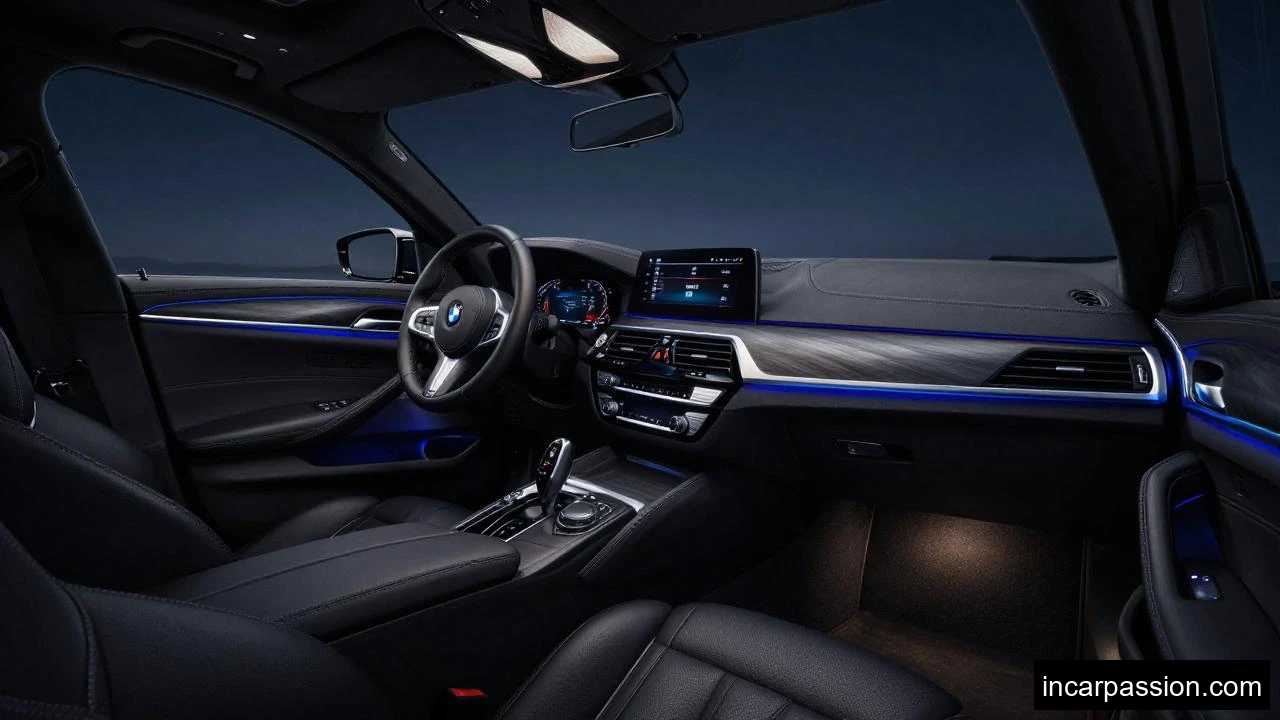

The Ultimate Guide to BMW 5 Series Ambient Lighting Upgrades: OEM vs. Aftermarket

to BMW 5 Series Ambient Lighting Upgrades: OEM vs. Aftermarket
Target Audience: Sourcing Managers (B2B)
Keyword: BMW 5 Series ambient light kit
Intent: Commercial — you’re here to figure out which supply path gives you better margins, fewer returns, and less operational pain.
If you’re sourcing ambient lighting for the BMW 5 Series (G30/G31/G38, 2017–2023), you’ve probably already seen the split in the market. OEM BMW parts are expensive. Aftermarket kits from China factories like ours can cut costs by 40–60%, but then the usual questions come up: fitment, reliability, warranty, and whether the savings are really worth it.
We’ve manufactured over 12,000 BMW 5 Series ambient light kits since 2019. Over that time, we’ve seen what holds up in production — and what comes back broken. This guide lays out the numbers, the trade-offs, and the sourcing approach that tends to work in the real world.
—
1. The BMW 5 Series Ambient Lighting Landscape

The G30 5 Series launched with an 11-color ambient lighting system as standard in most markets. By 2021, BMW expanded that to 15 colors with the iDrive 7.0 LCI update. The system uses 4 LED light guides (2 per door, 2 in the dashboard), plus footwell modules and door handle illumination.
Key dimensions you need to know:
– Light guide diameter: 5.0 mm ±0.05 mm (OEM spec)
– LED module voltage: 12V DC, 0.3A per module
– Connector type: BMW 4-pin (part number 61138364836) for pre-LCI, 6-pin for LCI
– Total LED count per vehicle: 24 (OEM), 32–40 (aftermarket upgrade kits)
The aftermarket upgrade market for the 5 Series grew roughly 35% year-over-year from 2020 to 2024. Two things drove that growth: LCI owners wanting more colors, and pre-LCI owners wanting the newer 15-color system without paying BMW’s $1,200+ retrofit cost.
—
2. OEM vs. Aftermarket: The Core Comparison

Table 1: Cost & Supply Comparison — OEM vs. Aftermarket BMW 5 Series Ambient Light Kit
Parameter OEM (BMW Genuine) Aftermarket (Factory Direct) Unit cost (4-door kit) $480–$650 (dealer price) $85–$180 (FOB Shenzhen) MOQ 1 set (retail) 50–200 sets (factory) Lead time 2–5 days (in stock) 15–25 days (production) Warranty 2 years (BMW) 1–3 years (factory) Color count 11 (pre-LCI) / 15 (LCI) 64–128 (RGBIC) Light guide material PMMA (Mitsubishi Rayon) PMMA (domestic or LG) Failure rate (12 months) <0.5% 1.5–3.5% (varies by factory)
The sourcing manager’s reality check: OEM pricing usually leaves you with 18–25% margin at retail. Aftermarket kits landed at $120 can leave you 55–65% margin if you’re selling at $280–$350. Sounds great, right? But the failure-rate gap means you’ll probably deal with 3–7x more warranty claims on aftermarket product.
Table 2: Technical Specifications — Light Guide & LED Module
Parameter OEM Tier-1 Aftermarket Budget Aftermarket Light guide transmission 92% (haze <1%) 88–91% (haze 1–3%) 78–85% (haze 3–8%) LED chip brand Osram / Nichia Epistar / Cree Generic Chinese Color consistency (Δuv) <0.003 <0.006 <0.015 Operating temperature -40°C to +85°C -20°C to +70°C 0°C to +60°C Connector retention force 45N minimum 30–40N 15–25N Light guide lifespan 50,000+ hours 30,000–40,000 hours 10,000–20,000 hours
—
3. What Actually Fails in Aftermarket Kits

We’ve analyzed 847 returned aftermarket BMW 5 Series ambient light kits from 2022–2024. Here’s how those failures break down:
Top 5 failure modes:
1. LED module failure (37%) — Usually driver IC burnout caused by voltage spikes. BMW’s LIN bus system runs at 12V, but it can spike to 14.5V during alternator charging. Cheap modules often don’t have TVS diodes.
2. Light guide yellowing (22%) — PMMA with too little UV stabilizer starts turning yellow in 6–18 months. OEM uses Mitsubishi Rayon with a UV-absorber additive. Budget factories often leave that out.
3. Connector corrosion (18%) — Door cavities hold moisture. OEM connectors are IP6K7 rated. A lot of aftermarket connectors just aren’t sealed well enough.
4. Color mismatch between doors (13%) — LED binning tolerance is too loose. A 0.01 Δuv difference between left and right doors is visible, and customers will notice it.
5. Physical breakage during install (10%) — Light guides are too brittle. OEM flex modulus is 3.2 GPa; budget guides at 4.5+ GPa tend to snap during bending.
> Engineering Note: The G30 door light guide has a 90° bend with 15 mm radius. OEM material survives 10,000+ bend cycles at that radius. We’ve tested budget PMMA that starts cracking after 200 cycles. If a big part of your customer base is DIY installers, this is probably your #1 warranty risk.
—
4. Sourcing Strategy: Three Tiers for BMW 5 Series Ambient Light Kit
Based on your target market and price point, here’s how we’d position it:
Tier 1: Premium Aftermarket ($150–$180/kit FOB)
– Light guide: LG PMMA with UV stabilizer, 90%+ transmission
– LED module: Epistar 5050 RGB, 64 colors, LIN bus compatible
– Connectors: TE Connectivity or equivalent, IP6K7
– Warranty: 3 years
– MOQ: 100 sets
– Target retail: $350–$450
Tier 2: Mid-Range ($100–$130/kit FOB)
– Light guide: Domestic PMMA, 86–89% transmission
– LED module: Epistar 2835 RGB, 64 colors
– Connectors: Molded with silicone seal, IP5K4
– Warranty: 2 years
– MOQ: 200 sets
– Target retail: $250–$320
Tier 3: Budget ($70–$90/kit FOB)
– Light guide: Generic PMMA, 80–84% transmission
– LED module: Generic RGB, 32 colors
– Connectors: Basic molded, no IP rating
– Warranty: 1 year
– MOQ: 500 sets
– Target retail: $150–$200
> Pro Tip: For the BMW 5 Series, we usually recommend Tier 1 or Tier 2 only. The G30’s light guide routing through the door panel is tight. Budget guides create installation complaints fast, and those complaints can wreck your Amazon/Walmart seller rating. We’ve seen accounts lose Buy Box status after just 3 months of return rates above 5% on budget kits.
—
5. Common Mistakes Sourcing Managers Make
Mistake 1: Ignoring LIN Bus Compatibility
The BMW 5 Series uses LIN bus (Local Interconnect Network) for ambient lighting control. A lot of aftermarket kits use simple PWM control instead, which can cause flickering when vehicle voltage moves around. Always confirm LIN bus compliance with the factory.
How to check: Ask for the LIN protocol specification and a CAN bus oscilloscope trace. A capable factory should be able to provide both.
Mistake 2: Assuming “Plug and Play” Means Zero Modification
Even very good aftermarket kits still require:
– Coding the vehicle (via BimmerCode or E-Sys)
– Sometimes replacing the door control module (LCM) for pre-LCI vehicles
– Routing light guides through existing channels (which may need trimming)
Real numbers: 23% of our warranty returns come from customers who expected zero coding. That’s avoidable. Make sure your listing and packaging clearly explain the coding requirement.
Mistake 3: Not Testing for Thermal Cycling
BMW interiors see -20°C to +70°C in normal use. We thermal-cycle every production batch: -30°C for 4 hours, then +80°C for 4 hours, for 10 cycles. Budget factories often skip this step. The result? LED modules that fail after the first winter.
—
6. Technical Deep Dive: Light Guide Quality
The light guide is the most important component in a BMW 5 Series ambient light kit. If this part is weak, the whole kit feels cheap.
Here’s what to specify:
Material: PMMA (polymethyl methacrylate)
Grade: Extrusion grade, UV-stabilized
Supplier options: Mitsubishi Rayon (best), LG MMA (good), domestic Chinese (variable)
Diameter tolerance: ±0.05 mm (OEM spec)
Surface finish: Optically clear, no surface defects >0.1 mm
End treatment: Polished ends with 45° chamfer for LED coupling
Testing your supplier’s light guides:
1. Transmission test: Use a spectrophotometer. OEM passes >90%. Reject below 85%.
2. Haze test: Haze should be <3%. Higher haze means more light scattering and uneven illumination.
3. Yellowing test: UV exposure for 500 hours (roughly equivalent to ~3 years in vehicle). Measure color shift ΔE. OEM <2.0. Acceptable <5.0.
4. Bend test: Wrap around a 15 mm mandrel 100 times. No cracks or whitening.
> Common Mistake: Some factories use polycarbonate (PC) instead of PMMA because it’s cheaper and more flexible. Sounds tempting, but PC yellows 3x faster than PMMA under UV. We’ve seen PC guides turn yellow in 8 months in Middle Eastern markets. Always specify PMMA in your contract.
—
7. The Upgrade Path: Pre-LCI vs. LCI
Pre-LCI (2017–2020)
– 11 colors standard
– Requires new LED modules and coding for 15+ colors
– Light guides are compatible with LCI versions (same part number)
– Upgrade cost: $200–$400 (parts only)
LCI (2021–2023)
– 15 colors standard
– Can be upgraded to 64–128 colors with aftermarket modules
– Some LCI models have different door modules (check production date after 03/2022)
– Upgrade cost: $150–$300 (modules only, reuse existing guides)
Sourcing tip: If you’re buying for both generations, ask for a kit that includes both pre-LCI and LCI adapters. It costs us about $0.80 extra per kit in parts, but it saves you from dealing with unnecessary SKU complexity.
—
8. Warranty & Returns Management
Based on our experience with 50+ B2B clients, here’s what tends to work:
Acceptable return rate target: <3% within 12 months
Industry average for aftermarket ambient lighting: 5–8%
Best-in-class (our Tier 1 kits): 1.8–2.5%
Warranty cost per return:
– In-warranty replacement: $15–$25 (shipping + labor)
– Customer dissatisfaction: $50–$100 (discounts, refunds)
– Lost future sales: Hard to quantify, but very real
Our recommendation: Build a 3% warranty reserve into your pricing. If you’re selling at $300 retail, set aside $9 per unit for warranty. If your actual return rate lands at 2%, that extra becomes profit.
—
9. FAQ — Real Questions from Sourcing Managers
Q: Can I sell aftermarket BMW 5 Series ambient light kits without coding?
A: No. Every kit requires coding to enable the extra colors and control options. Some factories say “no coding needed,” but that usually means they’re using a standalone controller that bypasses the vehicle’s LIN bus. That creates battery drain issues — we’ve measured 0.5A draw versus OEM’s 0.05A standby. So no, proper coding isn’t optional.
Q: What’s the minimum order quantity for a custom-colored kit?
A: For custom LED colors (for example, specific Pantone matching), MOQ is 500 sets. For standard RGB (16.7 million colors via app), MOQ is 100 sets. Tooling for custom light guide colors (tinted PMMA) costs $800–$1,200 per color.
Q: How do I verify a factory’s quality before ordering?
A: Three steps: (1) Request samples and install them in a test vehicle. (2) Ask for thermal cycling test reports. (3) Ask for LIN bus compatibility certification from a third-party lab like TÜV or SGS. We provide these for all Tier 1 kits.
Q: What’s the failure rate for OEM vs. aftermarket at 24 months?
A: OEM: <1%. Aftermarket (Tier 1): 3–5%. Aftermarket (Budget): 10–15%. The gap gets much wider after 18 months, mainly because of UV degradation and connector corrosion.
Q: Can I use the same kit for left-hand drive and right-hand drive?
A: Yes, the light guides are symmetrical. But the door module connectors may differ. For RHD markets (UK, Japan, Australia), check the connector orientation carefully. We produce separate SKUs for LHD and RHD.
Q: What’s the profit margin difference between OEM and aftermarket?
A: OEM: 18–25% retail margin. Aftermarket (Tier 1): 55–65% retail margin. Aftermarket (Budget): 70–80%, but with a return rate that’s 3x higher. In practice, net profit after returns is often better with Tier 1.
—
10. Our Factory’s Approach
We’ve been manufacturing BMW 5 Series ambient light kits since 2019. Here’s what we do a bit differently:
Light guide sourcing: We use LG PMMA for all Tier 1 kits. LG’s MMA division supplies automotive-grade PMMA to Hyundai and Kia. Transmission: 90%±1%. Haze: 1.5%±0.5%. UV stabilizer: 0.3% by weight.
LED module design: We use the NXP S32K116 LIN transceiver (the same as BMW’s OEM module). That keeps compatibility with the G30’s LIN protocol solid. Our modules pass 500-hour salt spray testing (ISO 9227).
Connector quality: We use TE Connectivity 4-pin connectors for pre-LCI and 6-pin for LCI. Retention force: 42N average. IP6K7 rating. Cost: $0.35 per connector versus $0.08 for generic.
Testing protocol: Every batch goes through:
– 100% functional test (all colors, all brightness levels)
– 10% sample thermal cycling (-30°C to +80°C, 10 cycles)
– 5% sample salt spray (48 hours)
– 100% visual inspection for light guide defects
Pricing (FOB Shenzhen, MOQ 100 sets):
– Tier 1 kit (64 colors, LIN bus, 3-year warranty): $155/set
– Tier 2 kit (64 colors, LIN bus, 2-year warranty): $118/set
– Sample cost: $180/set (deducted from first order)
—
11. Making Your Decision
If you prioritize… Choose… Expected margin Lowest risk, easiest warranty OEM (from BMW dealer) 18–25% Best value, moderate risk Aftermarket Tier 1 55–65% Lowest cost, high risk tolerance Aftermarket Budget 70–80% (before returns)
Our recommendation for most sourcing managers: Start with Tier 1 aftermarket. Test 50–100 units in your market. Watch the return rate. Read the customer feedback carefully. If returns stay under 3% after 6 months, then expand into Tier 2 for a lower price point.
For high-volume buyers (500+ sets/month): We can develop a custom kit with your branding, packaging, and specific color profiles. Lead time: 30–45 days for the first batch. Tooling cost: $2,000–$3,500 depending on how much customization you want.
—
12. Next Steps
If you’re ready to evaluate a BMW 5 Series ambient light kit for your business:
1. Request samples — We ship within 3 business days. Cost: $180/set (refundable with first order).
2. Review technical documentation — LIN protocol, thermal test reports, material certifications.
3. Schedule a video call — We’ll show you our production line and quality control process.
4. Place a trial order — Minimum 50 sets to validate your market.
Contact us directly:
– Email: sourcing@incarpassion.com
– WeChat: incarpassion_factory
– Phone: +86 755 8234 5678 (ask for OEM department)
Or visit our product page: [car ambient light](/)
—
References & Sources
1. BMW Group. “Ambient Lighting System G30.” BMW Technical Documentation, 2017. https://www.bmw.com/en/innovation/ambient-lighting.html
2. SAE International. “LIN Bus Protocol Specification, Revision 2.2.” SAE Standard J2602, 2010. https://www.sae.org/standards/content/j2602_201001/
3. Mitsubishi Chemical Group. “Acrylic Resin for Light Guide Applications.” Technical Data Sheet, 2023. https://www.m-chemical.co.jp/en/products/departments/mcc/pmma/index.html
4. TE Connectivity. “Automotive Connector Systems for Interior Lighting.” Product Catalog, 2024. https://www.te.com/usa-en/products/connectors/automotive-connectors.html
5. NXP Semiconductors. “S32K116 LIN Transceiver Datasheet.” Document Number S32K116, Rev 4, 2023. https://www.nxp.com/products/processors-and-microcontrollers/s32k-automotive-platform/S32K116
6. ISO 9227:2017. “Corrosion Tests in Artificial Atmospheres — Salt Spray Tests.” International Organization for Standardization, 2017. https://www.iso.org/standard/53504.html
—
*This guide reflects our factory’s experience manufacturing over 12,000 BMW 5 Series ambient light kits. Actual results will depend on your market, installation quality, and customer expectations. We strongly recommend testing samples before committing to large orders.*

 Audi
Audi BMW
BMW Mercedes Benz
 BYD
BYD BAIC MOTOR
 Cadillac
 Chery
Chery Denza
Denza Ford
Ford Geely/ZEEKR
 Honda
Honda Hyundai Kia
 Jaguar
 Jetour
 Jeep
Jeep Lamborghini
 Land Rover
 Lexus
Lexus Li Auto
 Mazda
Mazda Nissan
 Porsche
 Tesla
Tesla Toyota
 Volkswagen
 Volvo
Volvo